Written by Nell VH
A crisis statement is a clear, factual public update issued during an incident to acknowledge what happened, share verified information, and express empathy.
Its main goal is to protect trust when emotions are high and facts are still unfolding. This type of statement is commonly used during data breaches, product recalls, service outages, or cases of misconduct that create uncertainty and invite speculation.
When done right, it helps stabilize the narrative, reduce rumors, and signal that the situation is being handled responsibly.
This guide breaks down what a crisis statement is, highlights proven real-world examples, and provides a practical format you can rely on when time, clarity, and credibility matter most.
Key Takeaways
- A crisis statement prioritizes verified facts, empathy, and action while avoiding speculation.
- Effective examples act fast, isolate the issue, and commit to updates.
- A simple press release style format improves clarity and media pickup.
What Is a Crisis Statement and Why It Matters
A crisis statement is the first official message we issue during an emergency to acknowledge an incident and share what is confirmed. It serves as an initial crisis response that protects credibility while investigations continue and supports broader crisis and reputation management efforts when trust is under pressure.
A core purpose is to replace rumors with facts. We focus on who, what, when, and where that are verified, and we state what we are doing next. This approach supports crisis transparency and avoids defensive language that can escalate attention.
A crisis statement is often called a holding statement because it buys time. It signals leadership, care, and control while teams verify details. Unlike routine announcements, it emphasizes crisis facts only, avoids guessing, and commits to updates to follow.
Key attributes we rely on
- Speed with accuracy
- Empathy without overstatement
- Clear actions and contact paths
- Commitment to ongoing updates
Crisis Statement vs. Routine Announcements
A crisis statement differs in tone, structure, and purpose. It is not promotional. It is factual and grounded in present conditions.
Aspect
Crisis Statement
Routine Announcement
Goal
Stabilize trust during an emergency
Share planned news
Tone
Empathetic, factual
Optimistic, forward-looking
Timing
Immediate
Scheduled
Content
Verified 5Ws, actions, contacts
Features, benefits
Updates
Iterative
Usually one-time
We use this distinction to ensure the message fits the moment and reduces risk.
Proven Crisis Statement Examples That Work
Credits: notredamebusiness
Effective examples show rapid acknowledgment, clear action, and empathy. They isolate the issue and avoid speculation.
Tylenol recall example. In 1982, Johnson & Johnson responded to product contamination by immediately recalling 31 million bottles, prioritizing customer safety over profits, a response that communication scholars and business schools now study as exemplifying the CDC's Crisis and Emergency Risk Communication (CERC) principles of rapid response, empathy, credibility, and action promotion. The clarity and action-first stance protected long-term trust. [1]
Oil spill holding statement. Early statements from BP acknowledged the incident, expressed concern for those affected, and stated that investigations were underway. The structure demonstrated control without claiming unknown causes.
Data breach crisis statement. A modern example acknowledges impact, engages independent experts, and activates a crisis hotline. It lists concrete steps like password resets and monitoring while committing to updates.
These cases share common traits: fast acknowledgment, empathy, and visible actions.
Standard Crisis Statement Format You Can Reuse
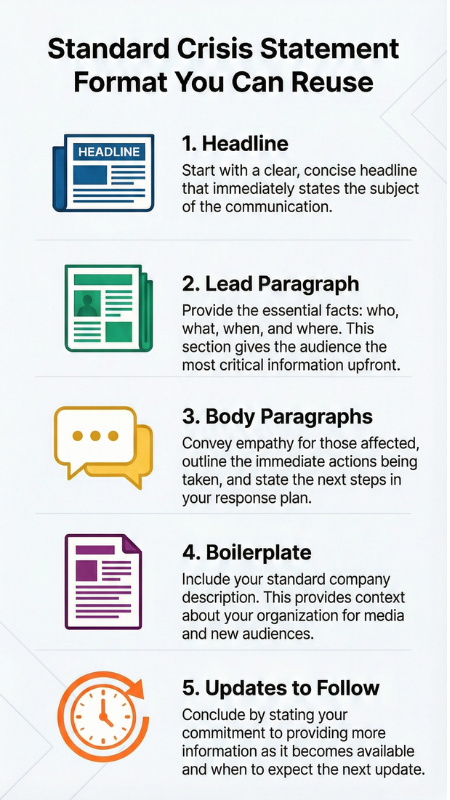
A clear format reduces errors when pressure is high. We recommend a crisis press release format that media can publish quickly, especially when teams are focused on crafting crisis statements that balance speed, accuracy, and accountability.
Headline
- Concise summary.
- Example: “[Company] Responds to [Incident] at [Location]”
Subheader or Lead Paragraph
- News-style lead with verified who, what, when, where.
Body Paragraphs
- Acknowledgment and empathy. State concern or apology if appropriate.
- Immediate actions. Investigations, safety steps, service changes.
- Next steps and contact info. Where updates will appear and how to get help.
Boilerplate
- Brief company description.
Updates to follow
- Set expectations for continued communication.
This structure supports crisis media response and consistent pickup across channels.
Writing the Headline and Lead With Precision
Start with facts. Keep the headline under one line and avoid adjectives. Use the lead to anchor the story with confirmed details.
Three short paragraphs help early clarity:
- Paragraph one states the incident and timing.
- Paragraph two names affected groups and safety priority.
- Paragraph three signals action and updates.
Then add a short list to reinforce actions:
- Investigation launched with experts
- Safety measures activated
- Support channels opened
This rhythm balances speed and readability.
Empathy, Apology, and Responsibility
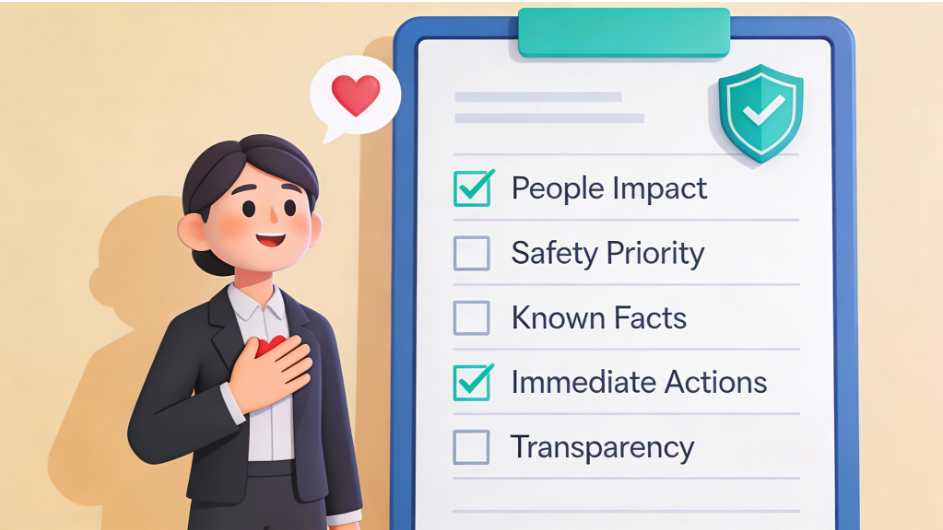
Empathy is essential when people are affected. We express concern without assuming causes or outcomes.
Five concise paragraphs work well here:
- Acknowledge impact on people
- State safety as the priority
- Explain what is known
- List immediate actions
- Commit to transparency
A sincere crisis apology is appropriate when responsibility is clear. Avoid absolutes. Avoid speculation. Keep language human and direct.
Actions, Updates, and Contact Paths
After empathy, actions matter most. We list steps already taken and those underway.
Use a short list to compress details:
- Expert review initiated
- Systems secured or services paused
- Crisis hotline activated
- Dedicated update page live
Follow with a paragraph that explains update cadence and where to find verified information. This supports crisis stakeholder communication and reduces inbound confusion.
Channels and Timing That Reduce Risk
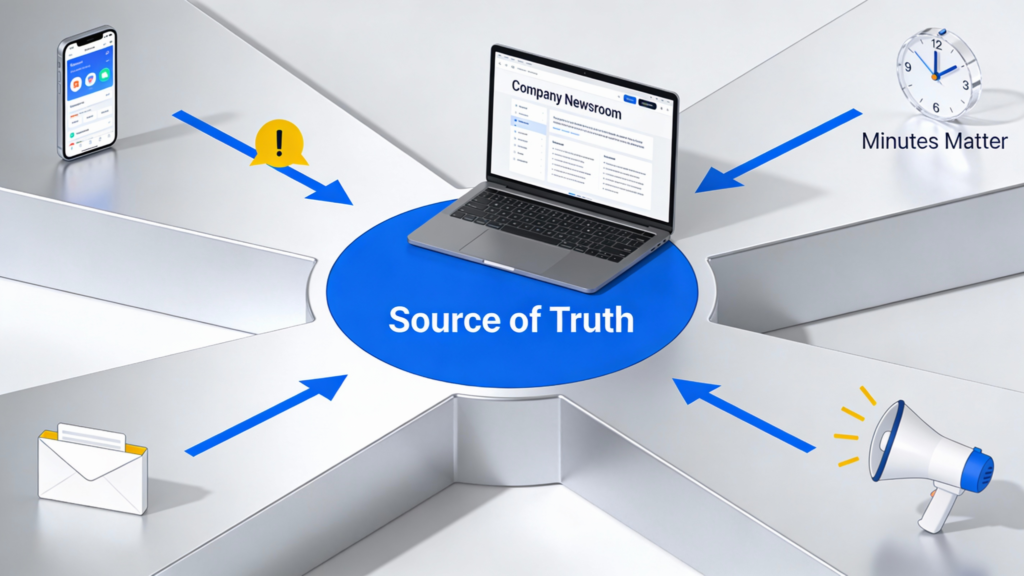
We release the statement across multiple channels at the same time to maintain consistency, supported by clearly defined crisis roles so approvals, updates, and responses don’t bottleneck when minutes matter.
Two short paragraphs set the approach:
- Official release for broad distribution
- Website announcement for a single source of truth
Then list channels:
- Website newsroom
- Social media statement
- Direct emails to affected customers
We update iteratively as facts are verified. This practice aligns with guidance from the Federal Trade Commission, which emphasizes timely notification and clear communication steps following security incidents, requiring covered entities to notify the FTC within 30 days of discovery of breaches affecting 500 or more consumers. [2]
Templates by Crisis Type
Pre-drafted templates save time. We tailor tone and actions by scenario.
Victim-type incident
- Lead with empathy
- Emphasize support resources
Accidental incident
- Explain what is known
- Detail corrective actions
Preventable incident
- Acknowledge responsibility
- Outline mitigation and oversight
A brief transition keeps flow before subtypes. Templates ensure crisis no speculation while maintaining speed.
A Simple Crisis Statement Template
Use this fill-in structure to move fast.
Headline: [Company] Responds to [Incident]
Lead: On [date], we became aware of [verified incident] at [location/service].
Empathy: We are concerned for those affected and prioritize safety.
Actions: We have [actions taken] and engaged [experts/authorities].
Next steps: Updates will be posted at [link]. Contact [email/phone].
This holding statement template supports clarity under pressure.
Measuring Effectiveness and Improving Updates

Effectiveness shows up in reduced speculation and consistent coverage. We track pickup accuracy, inbound questions, and sentiment shifts.
Two short paragraphs explain iteration:
- Update when facts change
- Correct errors promptly
Then list metrics:
- Media accuracy rate
- Support volume trends
- Update engagement
Health agencies like the FDA emphasize clear, timely updates during recalls to protect consumers . The same principle applies across incidents.
Common Mistakes to Avoid
Mistakes amplify attention. We avoid them deliberately.
Introduce the list with a sentence, then bullets:
- Delaying acknowledgment
- Overpromising outcomes
- Using defensive language
- Hiding contact paths
End with a paragraph that reinforces calm, factual updates and leadership presence.
FAQ
What is a crisis statement and how does it differ from a holding statement?
A crisis statement is an official crisis communication released when an organization faces a reputational crisis statement or emergency statement situation.
It provides a complete crisis response including crisis facts only, crisis action plan details, and crisis resolution steps.
A holding statement, by contrast, is an initial crisis response issued quickly, often within the golden hour, when you don't yet have all answers.
The holding statement template acknowledges the incident acknowledgment and shows crisis empathy while buying time for a verified crisis info investigation.
Both require crisis transparency and honest crisis communication. The holding statement might say "we're investigating and will update by 5pm," while the full crisis statement delivers the crisis 5Ws (who what when where why crisis) with specific crisis mitigation actions.
Think of holding statements as rapid crisis response bridges to comprehensive crisis press release formats.
What are the essential format elements every crisis press release format should include?
The crisis press release format follows journalism standards with specific structural elements. Start with a concise crisis headline that captures the issue without sensationalism, followed by a crisis subheader adding context.
The crisis lead paragraph delivers news style crisis lead answering the crisis 5Ws immediately, who, what, when, where, and why.
Your empathy paragraph crisis comes early, showing you understand human impact empathy on affected people.
The crisis body text provides technical crisis facts using verified crisis info with crisis no speculation. Include specific action steps crisis and next steps crisis showing your crisis action plan.
Add crisis contact info including a crisis hotline or investigation hotline number. Close with your crisis boilerplate describing your organization and "updates to follow" language signaling crisis follow-up update commitment. This structured format enables scannable content for journalists and stakeholders.
Can you provide crisis statement examples from real incidents?
Several crisis statement examples offer lessons. The Tylenol crisis example from 1982 shows Johnson Johnson recall statement prioritizing crisis safety priority over profits, they immediately pulled products nationwide and communicated transparently.
The BP oil spill holding statement initially failed by minimizing damage, teaching the importance to avoid crisis defensiveness.
Modern data breach crisis statement examples often include specific cyber attack crisis statement details about what data was exposed, when customers will be notified, and what protection steps the company is taking.
Product recall crisis message examples specify which batches are affected to isolate crisis problem rather than using broad context negatives about industry safety.
Executive misconduct statement examples demonstrate how crisis sincerity and sincere crisis apology language matter more than legal perfection.
Service outage crisis response examples from tech companies show iterative crisis updates keeping customers informed as restoration progresses.
How should organizations tailor crisis messaging for different audiences and channels?
Crisis stakeholder communication requires context tailor crisis approaches for each audience. A crisis internal memo to employees needs more detail about job security and operational impact than a crisis external release.
The crisis parent letter from schools during safety incidents uses plain language and emotional reassurance, while a crisis media response includes more technical crisis facts journalists need.
Channel matters too, a crisis social media statement needs brevity for mobile scanning with crisis key messages in the first sentence.
A crisis website announcement can be comprehensive with crisis Q&A sections. Customer crisis email should emphasize solutions and support resources, while press conference crisis settings allow for deeper crisis event description and real-time questions.
Your crisis communication plan should include crisis talking points adapted for each group. The crisis team coordinator ensures message consistency across channels while respecting audience-specific needs and concerns.
Crisis Statement Definition, Examples & Format in Practice
A strong crisis statement definition, examples & format framework gives us speed and control. We lead with facts, show empathy, and act visibly.
The format stays consistent while content adapts to the incident. This approach protects trust and keeps focus on resolution.
Next steps. When you need fast, reliable distribution and clear reporting for critical updates, publish your statement with NewswireJet to reach major outlets efficiently and keep stakeholders informed.
References
- https://egrove.olemiss.edu/hon_thesis/3128/
- https://www.ftc.gov/business-guidance/blog/2024/05/safeguards-rule-notification-requirement-now-effect
Related Articles